
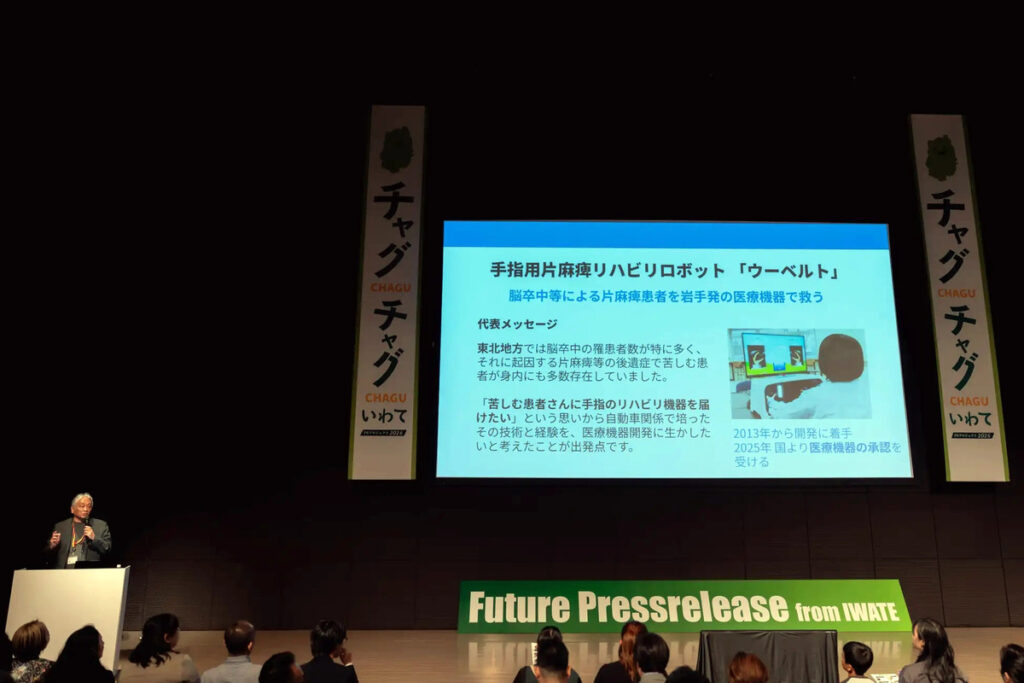
Tohoku Medical Systems Co., Ltd., a medical device startup based in Morioka, Iwate Prefecture, has won the Roadmap Award at the “Future Press Release from IWATE” competition. The award recognized the company’s 2036 vision for its rehabilitation robot, Ouvert, a hand-training medical device for patients with hemiplegia after stroke and other brain-related conditions.
This is not just a story about one award. It is a story about how Japan turns university research into practical tools for an aging society.
Tohoku Medical Systems was born as a venture connected to Iwate University and Tohoku University. Its roots are in robotics, medical engineering, and the long process of matching what engineers can build with what hospitals actually need. The company says Ouvert was developed through more than twelve years of trial and error, beginning in 2013 through collaboration with research institutions including Iwate University and Tohoku University.
Ouvert is officially titled the “Hand Robotic Exercise Training Device Ouvert.” The name comes from the French word meaning “open.” The device helps move the fingers of a paralyzed hand, aiming to prevent joint stiffness and improve range of motion. Instead of relying only on a therapist’s hands, the patient places the affected hand into the robot, and the machine assists finger movement with motor power.
The device also uses a leader-follower system. The patient moves the healthy hand, and the robot helps the paralyzed hand follow the same movement. A screen shows a mirrored image, and game-like functions are used to encourage patients to continue training. In simple terms, the machine tries to make rehabilitation more repeatable, more motivating, and less dependent on the physical strength of the therapist.
Japan needs this kind of technology because rehabilitation is becoming one of the country’s major social issues. Stroke can leave people unable to use one side of the body. Walking recovery often receives attention because it affects whether patients can return home, but hand and finger recovery is also deeply connected to daily dignity. Opening a door, holding chopsticks, buttoning a shirt, writing a name, using a smartphone, or touching a family member’s hand are small actions that shape a person’s life.
That is why Ouvert matters. Patients may gain more chances to train their hands. Families may see loved ones regain daily abilities. Physical and occupational therapists may be able to reduce some of the repetitive physical burden of manual rehabilitation. Hospitals may be able to provide more consistent training even when medical workers are limited. Local manufacturers may also gain a new model for building high-value medical devices outside Tokyo.
The background is also important. Tohoku University is one of Japan’s most respected national universities. It has produced well-known figures in literature, science, business, and culture, including Kotaro Isaka, Koichi Tanaka, Makiko Uchidate, Kiichiro Toyoda, Shoichiro Toyoda, and Yoshihiro Inayama. But the university’s value is not only in famous names. Its deeper strength is a tradition of combining academic knowledge with practical invention.
Nearly a century ago, Tohoku University researchers were already working across medicine and engineering. One famous example is the Magnoscope, an electric stethoscope developed in 1929 and known as an early achievement of medical-engineering collaboration in Japan. Ouvert stands on that same historical line: a medical problem from the hospital, robotics knowledge from the university, manufacturing skill from the region, and a product designed for real patients.
The Roadmap Award was given to the company that most clearly showed a realistic path toward the future. In this case, the roadmap is not only a business plan. It is a map of how Japan may respond to aging, labor shortages, regional decline, and medical inequality.
If Ouvert spreads, the people who benefit first are stroke patients, their families, therapists, and hospitals. But the wider meaning is larger. It suggests that Japan’s local universities and regional startups can create technology for global aging societies. What begins in Morioka could eventually become useful in the United States, Europe, Asia, and any country facing the same question: how can people recover movement, dignity, and independence when medical workers are not enough?

Notes
For American readers, this story may look different from a typical Silicon Valley startup story. In the United States, startup success is often measured by funding rounds, rapid scaling, and market disruption. In Japan, especially in medical technology, the road is often slower. A device must be safe, clinically meaningful, manufacturable, and acceptable to hospitals. Ouvert took more than twelve years to reach medical device approval, showing the long timeline often required for deep technology.
The word “university venture” is also important. In Japan, many advanced technologies begin inside national universities. Professors, researchers, engineers, hospitals, local governments, and manufacturers may work together before a company is formed. This is called industry-academia collaboration. In this case, the idea is not simply that a university gave its name to a startup. The important point is that university robotics knowledge was shaped by medical needs until it became a usable medical device.
Iwate Prefecture is far from Tokyo and is not usually seen by foreign readers as a startup center. That makes this story more meaningful. Japan is trying to create innovation outside the capital. If regions like Iwate can produce approved medical devices, local economies can move beyond agriculture, tourism, and traditional manufacturing into high-value healthcare technology.
Tohoku University adds historical weight to the story. The university is famous for research, openness, and practical science. Its connection to medical engineering goes back to early twentieth-century Japan, when engineers and doctors worked together on devices such as the electric stethoscope. Ouvert is a modern continuation of that culture.
The biggest social question is not whether one robot can solve rehabilitation. It cannot. The real question is whether Japan can build systems where robots, therapists, hospitals, and families work together. Ouvert points toward a future where technology does not replace care, but helps care reach more people.
Comments