
The Wright Brothers News | Space & Science | November 23, 2026
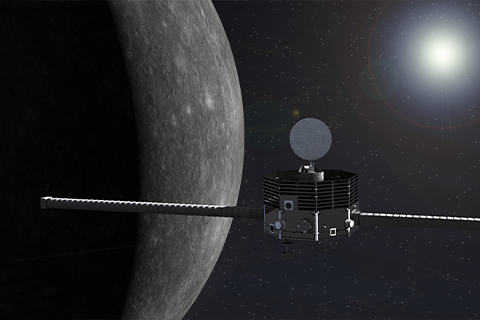
Eight years. Nearly 10 billion kilometres of interplanetary travel. Nine planetary flybys. On November 21, 2026, Europe’s and Japan’s BepiColombo spacecraft achieved capture into orbit around Mercury, the closest planet to the Sun. The milestone makes it only the second mission to orbit Mercury, after NASA’s MESSENGER.
The arrival was not flawless. The European Space Agency (ESA) reported on November 22 that a software issue caused a shorter-than-planned thruster burn. The spacecraft was reported safe, while engineers investigated the anomaly. The combined spacecraft is in orbit, but the two scientific orbiters have not yet separated, and routine scientific operations are planned for April 2027.
This is more than a spacecraft story. Who is measuring Mercury’s thin sodium atmosphere? Who is trying to map the metals in its rocks? Who is testing the planet’s gravity, and which professors, students and laboratories are actually building the instruments?
To find out, we followed the research from space agencies to university departments – and then compared those laboratories with the teams investigating the Moon, asteroids, Saturn and Jupiter.
Why is Mercury so difficult to explore?
Mercury is smaller than Earth and barely larger than the Moon. Yet reaching it is extraordinarily hard. A spacecraft falling deeper into the Sun’s gravity well must shed enough orbital energy to be captured by Mercury rather than race past it. Intense sunlight and extreme temperature changes also test its hardware.
Mercury’s mysteries justify the effort. It has an unusually large metallic core and a magnetic field. Its tiny exosphere – a cloud of individual atoms rather than a breathable atmosphere – changes as sunlight, solar particles and microscopic impacts strike the surface. Even water ice can persist inside permanently shadowed polar craters.
Only three spacecraft missions have reached Mercury: NASA’s Mariner 10 (flybys in 1974-75), NASA’s MESSENGER (in orbit from 2011 to 2015) and BepiColombo. No astronaut has visited Mercury. Until now, the planet’s close-up history has largely been written by American robotic missions.
Two orbiters, two different scientific jobs
BepiColombo brings together ESA’s Mercury Planetary Orbiter (MPO) and JAXA’s Mio, also known as the Mercury Magnetospheric Orbiter.
MPO will study the planet itself: its mineral and elemental composition, volcanic and tectonic history, surface temperatures, shape, gravity and interior. Its instruments include the Mercury Imaging X-ray Spectrometer (MIXS), the BepiColombo Laser Altimeter (BELA) and the Mercury Orbiter Radio science Experiment (MORE).
Mio will study Mercury’s environment: the magnetic field, electrically charged plasma, solar-wind interactions, electromagnetic waves, sparse sodium exosphere and microscopic dust. Japanese university teams are central to several of these investigations.
Together, the probes should enable researchers to relate a change in the solar wind to events in Mercury’s magnetic environment, its exosphere and even its surface. That connection is a major reason two orbiters can answer questions one spacecraft alone could not.
Meet the laboratories behind the science
Japan: Professor Ichiro Yoshikawa and the University of Tokyo’s Yoshikawa-Yoshioka Laboratory
Institution: Graduate School of Frontier Sciences, the University of Tokyo
Instrument: Mercury Sodium Atmosphere Spectral Imager (MSASI) on Mio
Research question: Where do the sodium atoms surrounding Mercury come from, and why does their distribution change?
Mercury cannot hold an Earth-like atmosphere. Instead, atoms are released from its surface by solar radiation, charged particles and tiny impacts.
Professor Ichiro Yoshikawa, principal investigator for MSASI, and the Yoshikawa-Yoshioka Laboratory helped develop the instrument that will map sodium around the planet.
The laboratory also reports contributions to a detector for the PHEBUS ultraviolet instrument and to calibration and analysis related to the Solar Particle Monitor.
The scientific prize is not merely a picture of sodium. By comparing sodium distributions with the solar wind and surface conditions, the team hopes to learn how a planet’s surface and near-space environment continually influence one another.
Japan: Professor Yasumasa Kasaba at Tohoku University’s Planetary Plasma and Atmospheric Research Center
Institution: Tohoku University, Planetary Plasma and Atmospheric Research Center (PPARC)
Instrument: Plasma Wave Investigation (PWI) on Mio
Research question: How does Mercury respond when energetic solar particles strike its miniature magnetosphere?
Professor Yasumasa Kasaba is principal investigator for Mio’s PWI experiment. The team measures electric fields, radio signals and plasma waves. These measurements matter because waves help move energy and charged particles through a magnetosphere.
In a related analysis, Associate Professor Mitsunori Ozaki of Kanazawa University has worked with PWI observations suggesting the presence of unexpectedly cold electrons near Mercury.
The possibility challenges earlier expectations about such a thinly protected planetary environment. This is exactly the kind of discovery that can emerge from specialist laboratories rather than agency headquarters alone.
Japan: Masanori Kobayashi at Chiba Institute of Technology’s Planetary Exploration Research Center
Institution: Chiba Institute of Technology, Planetary Exploration Research Center (PERC)
Instrument: Mercury Dust Monitor (MDM) on Mio
Research question: Are small particles near Mercury interplanetary dust, or fragments kicked off Mercury’s own surface?
Masanori Kobayashi, a senior researcher at PERC and principal investigator for MDM, leads an instrument that detects momentum from tiny impacts on a sensor.
By combining those signals with spacecraft position and motion, researchers can estimate the dust particles’ origin and trajectories. PERC is directly involved in sensor calibration, testing and data analysis.
This is a reminder that the most revealing space hardware is not always developed at the university with the highest overall league-table ranking.
United Kingdom: Professor Emma Bunce and the University of Leicester’s Institute for Space
Institution: University of Leicester, Institute for Space / School of Physics and Astronomy
Instrument: Mercury Imaging X-ray Spectrometer (MIXS) on MPO
Research question: Which chemical elements are present in Mercury’s rocks, and how does the space environment change the surface?
Professor Emma Bunce, MIXS principal investigator and director of Leicester’s Institute for Space, leads the international team behind an imaging X-ray instrument.
Energetic solar X-rays cause elements in Mercury’s surface to fluoresce. MIXS detects that emitted X-ray signal to build a map of the planet’s composition.
The team has already completed a striking test. In September 2026, MIXS observed the Crab Nebula, about 6,500 light-years away, to calibrate its imaging performance before Mercury operations.
Leicester announced the results on November 20.
Dr Adrian Martindale, the instrument scientist, has worked on the mission since joining as an undergraduate in 2003. The team also remembers Professor George Fraser, the original MIXS principal investigator, who died in 2014.
Decades of individual scientific careers are woven into this instrument.
Switzerland: University of Bern’s Planetary Imaging Group
Institution: University of Bern, Physics Institute / Planetary Imaging Group
Instrument: BepiColombo Laser Altimeter (BELA) on MPO
Research question: What do Mercury’s mountains, basins and fault systems reveal about its geological evolution?
The Planetary Imaging Group, historically led by Professor Nicolas Thomas, helped develop BELA in collaboration with the German Aerospace Center (DLR).
Bern names Dr Antoine Pommerol as its current instrument principal investigator.
BELA fires laser pulses toward Mercury and measures the returning signals to reconstruct surface elevations. Its digital terrain maps will help scientists examine craters, tectonics and the planet’s shape.
Italy: Professor Luciano Iess and Sapienza University’s Radioscience Laboratory
Institution: Sapienza University of Rome, Department of Mechanical and Aerospace Engineering / Radioscience Laboratory
Instrument: Mercury Orbiter Radio science Experiment (MORE) on MPO
Research question: How large and how liquid is Mercury’s core – and can extremely precise tracking test Einstein’s relativity?
Professor Luciano Iess leads Sapienza’s Radioscience Laboratory and is the principal investigator for MORE.
His team uses precise radio tracking of the spacecraft to probe Mercury’s gravity field, rotation and interior. Radio science can also test aspects of gravitational physics by tracking how signals and spacecraft trajectories behave under the influence of the Sun.
This team also works on missions beyond Mercury, including the Jupiter-bound JUICE spacecraft: one university laboratory can investigate two very different planetary systems using related measurement techniques.
Finland: Professor Emilia Kilpua and the University of Helsinki Space Physics Research Group
Institution: University of Helsinki, Department of Physics / Space Physics Research Group
Instrument: Solar Intensity X-ray and particle Spectrometer (SIXS) on MPO
Research question: How do solar storms irradiate Mercury, and what can that teach us about space weather near Earth?
Professor Emilia Kilpua is principal investigator for SIXS, a Finnish-led instrument that monitors energetic solar particles and X-rays.
Recent research using Mercury flyby measurements showed how energetic particles can penetrate the planet’s relatively weak magnetic protection and bombard its surface.
Professor Rami Vainio of the University of Turku is a co-principal investigator and has emphasized the value of these observations for understanding extreme space-weather conditions.
The United States: From Mercury to asteroid Bennu
America’s Mercury record began with Mariner 10, which used a Venus gravity assist, and continued with MESSENGER, designed and operated by Johns Hopkins University’s Applied Physics Laboratory (APL).
MESSENGER mapped the planet and provided strong evidence for water ice in polar shadows.
Its principal investigator was Sean Solomon, affiliated with Columbia University for the mission, while Ralph McNutt served as project scientist at APL.
The American university story also extends well beyond planets.
At the University of Arizona’s Lunar and Planetary Laboratory, Professor Dante Lauretta led NASA’s OSIRIS-REx asteroid-sample mission.
The spacecraft returned material from Bennu in 2023; laboratories are studying its minerals and organic chemistry to better understand the early Solar System.
Bennu is an asteroid, not a planet, but its samples may help explain the materials from which planets formed.
United Kingdom again: Professor Michele Dougherty’s Space Magnetometer Laboratory at Imperial College London
Institution: Imperial College London, Space Magnetometer Laboratory
Missions: Cassini at Saturn and ESA’s JUICE mission to Jupiter’s icy moons
Research question: Can magnetic measurements reveal hidden oceans beneath icy moons?
Professor Michele Dougherty led the magnetometer investigation on NASA’s Cassini mission to Saturn.
Her team’s magnetic measurements were pivotal to studying Saturn’s moon Enceladus and its surprising activity.
She is also principal investigator for J-MAG aboard JUICE, which is traveling toward Jupiter.
Her laboratory builds magnetometer hardware that will help investigate Ganymede’s magnetic field and the conductive oceans suspected beneath icy shells.
This connects the Mercury story to an important larger question: Earth is not the only world whose magnetic environment reveals secrets about its interior.
China: Professor Hejiu Hui and the lunar-sample researchers at Nanjing University
China has not sent a spacecraft to Mercury, but its exploration record includes the Moon, Mars and asteroids.
The Chang’e-6 mission returned the first samples from the Moon’s far side in 2024.
Scientists at the Chinese Academy of Sciences, including the Institute of Geology and Geophysics and the National Astronomical Observatories, have worked with Nanjing University and others to examine those samples.
A group involving Professor Hejiu Hui at Nanjing University investigated the water content of lunar mantle material inferred from the returned far-side basalt.
Their work pointed to a relatively dry mantle source compared with some measurements from the near side.
Other analyses examine ancient volcanism, magnetic fields and the effects of enormous impacts.
China’s Tianwen-1 achieved a Mars landing in 2021, while Tianwen-2, launched in 2025, targets an asteroid sample-return mission.
Those achievements are independent of BepiColombo: China is not a partner in the Mercury orbiter mission.
A quick guide: Which worlds are different countries and agencies studying?
| Country or partnership | Representative destination and mission | What scientists want to understand |
|---|---|---|
| United States / NASA | Mercury: Mariner 10 and MESSENGER; asteroid Bennu: OSIRIS-REx; Jupiter’s moon Europa: Europa Clipper (en route) | Mercury’s core and polar ice; early Solar System chemistry; Europa’s potential habitability |
| Japan / JAXA | Mercury: Mio; Martian moon Phobos: MMX; asteroids: Hayabusa missions | Plasma, sodium and dust at Mercury; origins of Martian moons; asteroid samples |
| Europe / ESA and partners | Mercury: MPO; Jupiter’s icy moons: JUICE (en route) | Surface geology and gravity at Mercury; magnetic fields and subsurface oceans at Jupiter’s moons |
| China / CNSA | Moon: Chang’e-6; Mars: Tianwen-1; asteroid: Tianwen-2 | Lunar far-side evolution, Martian geology and climate, asteroid origins |
| India / ISRO | Moon: Chandrayaan-3; Mars: Mars Orbiter Mission | Lunar soil temperature, seismic activity, elemental composition and the Martian atmosphere |
The Moon is Earth’s natural satellite, Phobos and Europa are moons, and Bennu is an asteroid. Treating each as a planet would distort the science.
Likewise, a mission that is en route should not be described as already operating at its future destination.
Where do these universities rank worldwide?
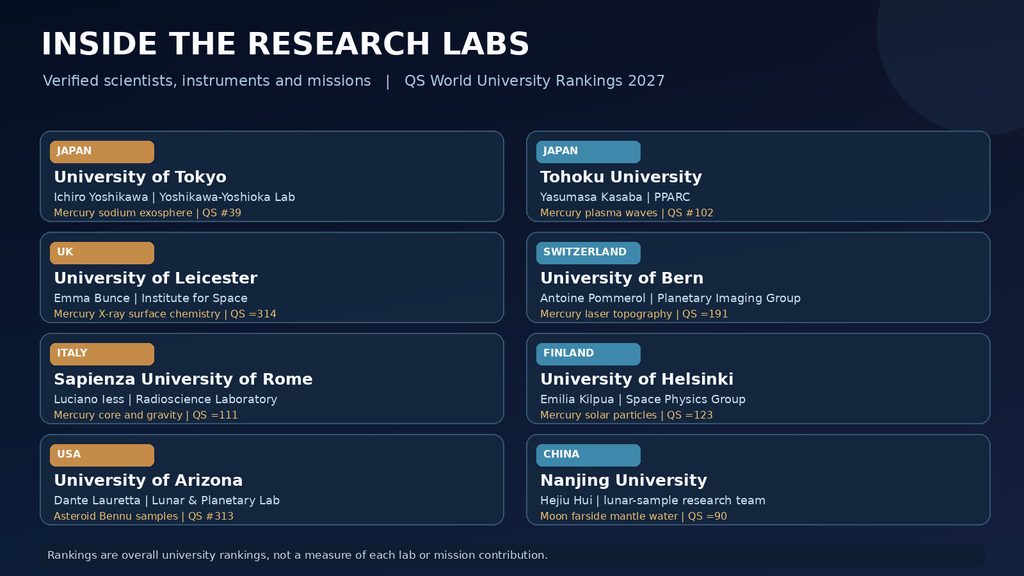
The following figures use the QS World University Rankings 2027 for consistency. They are overall university rankings, not a measure of a particular laboratory’s scientific impact. Institutions not listed here should not be assumed to have no relevant research.
| University | Country | QS 2027 world rank | Research team or mission discussed |
|---|---|---|---|
| Imperial College London | United Kingdom | =2 | Michele Dougherty; Space Magnetometer Laboratory; Cassini/JUICE |
| University of Tokyo | Japan | 39 | Ichiro Yoshikawa; Yoshikawa-Yoshioka Laboratory; Mercury sodium |
| Nanjing University | China | =90 | Hejiu Hui and collaborators; Chang’e-6 far-side lunar samples |
| Tohoku University | Japan | 102 | Yasumasa Kasaba; PPARC; Mio plasma waves |
| Sapienza University of Rome | Italy | =111 | Luciano Iess; Radioscience Laboratory; Mercury gravity |
| University of Helsinki | Finland | =123 | Emilia Kilpua; Space Physics Research Group; SIXS |
| University of Bern | Switzerland | =191 | Planetary Imaging Group; BELA laser altimetry |
| University of Arizona | United States | 313 | Dante Lauretta; Lunar and Planetary Laboratory; asteroid Bennu |
| University of Leicester | United Kingdom | =314 | Emma Bunce; Institute for Space; MIXS X-ray spectroscopy |
Two lessons stand out.
First, high-ranked universities such as Imperial and the University of Tokyo are deeply involved in spacecraft science.
Second, laboratories at specialist or lower-ranked institutions can be indispensable: Leicester leads a spaceborne X-ray imager, Bern built a planetary laser altimeter, and Chiba Institute of Technology developed and calibrated a dust detector on a mission to another planet.
What happens next at Mercury?
As of November 23, 2026, orbital capture has been reported, but engineering teams are still assessing the shorter-than-planned insertion burn.
Mio’s separation from MPO remains scheduled for December 9-10, followed by the release of its sunshield, further orbit adjustments and commissioning.
Routine science is planned to begin on April 6, 2027, subject to the spacecraft’s actual condition and operational decisions.
The unanswered questions are as compelling as the journey:
- Does Mercury’s sodium cloud change during solar storms?
- What minerals hide inside its ancient craters?
- How much of its gigantic core remains molten?
- Can measurements from two different orbits explain how the Sun continually reshapes a small planet?
When the first regular data arrive, the answers will not come from a spacecraft alone.
They will come from research groups: a sodium-camera laboratory in Tokyo, plasma physicists in Sendai, X-ray specialists in Leicester, radio scientists in Rome, laser-imaging experts in Bern, and many more people whose names seldom appear in a rocket-launch headline.
That is the deeper story of planetary exploration: a spacecraft travels millions or billions of kilometres, but the discoveries are made by scientists and students on Earth.
Sources and further reading
- ESA: BepiColombo Mercury arrival timeline
- Reuters: Orbital capture and the November 22 software issue
- JAXA: Mio instrument and science team
- University of Tokyo: Yoshikawa-Yoshioka Laboratory
- Tohoku University: Planetary Plasma and Atmospheric Research Center
- Chiba Institute of Technology: Mercury Dust Monitor
- University of Leicester: MIXS calibration, November 20, 2026
- University of Bern: BELA and BepiColombo
- Sapienza University: Radioscience Laboratory
- University of Helsinki: Professor Emilia Kilpua
- Imperial College London: JUICE and Space Magnetometer Laboratory
- University of Arizona: Dante Lauretta and OSIRIS-REx
- Chinese Academy of Sciences: Chang’e-6 lunar research
- Nanjing University: lunar far-side mantle-water analysis
- ISRO: Chandrayaan-3 scientific instruments
- NASA: MESSENGER at Johns Hopkins APL
- QS World University Rankings 2027
Editorial note: Illustrations supplied with this article are original explanatory artwork, not official spacecraft photographs or actual observational data. Mission plans and dates are subject to change.
Comments