
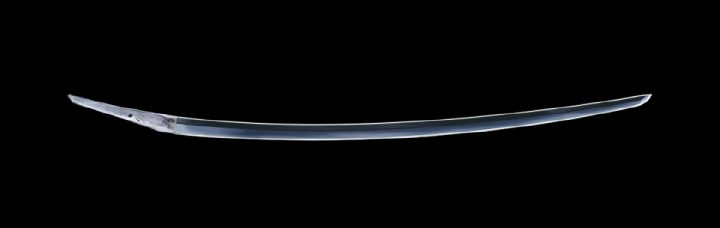
Mikazuki Munechika, recognized as one of the “Five Great Swords of Japan,” is widely regarded as one of the most refined and historically important Japanese swords ever created. The blade is believed to have been forged during the late Heian period by the Kyoto swordsmith Sanjo Munechika, whose name remains highly respected in the history of Japanese craftsmanship.
The sword’s name, “Mikazuki,” meaning “crescent moon,” is associated with the subtle crescent-shaped reflections that appear within the blade’s surface and temper pattern. These delicate details, combined with the sword’s elegant curvature and balanced proportions, have made it a celebrated example of early Japanese tachi design.
Historical traditions suggest that the sword was preserved and passed down among powerful military and political families throughout Japanese history. It has been associated with the Ashikaga shogunate as well as later ruling authorities during the Toyotomi and Tokugawa periods. Because of its artistic and cultural significance, the sword was valued not only as a weapon, but also as an important cultural treasure representing heritage, prestige, and craftsmanship.
Today, Mikazuki Munechika continues to attract attention from historians, collectors, museums, and enthusiasts of Japanese art around the world. It is frequently introduced internationally as one of the finest examples of traditional Japanese sword culture, admired for both its historical background and exceptional craftsmanship.
Annotation
In the United States, antique Japanese swords are often appreciated as historical artifacts and works of craftsmanship rather than as weapons. Collectors and museums frequently study Japanese blades for their forging techniques, temper patterns, and preservation history. High-quality swords connected to famous swordsmiths or historical periods are especially valued in the American collector market.
Specialized collectors in the U.S. often compare Japanese swords to European medieval arms or fine art pieces because of the level of detail involved in their construction. Auction houses, museums, and cultural exhibitions regularly feature Japanese swords alongside samurai armor and traditional Japanese artwork as part of broader historical collections.
Interest in authentic Japanese swords has also grown through martial arts communities, historical research groups, and cultural exhibitions across North America. Many collectors view these blades as important examples of Japanese cultural heritage, emphasizing preservation, documentation, and historical understanding. Famous swords such as Mikazuki Munechika are therefore introduced internationally not only for their beauty, but also for their role in Japanese history and traditional craftsmanship.
Comments