
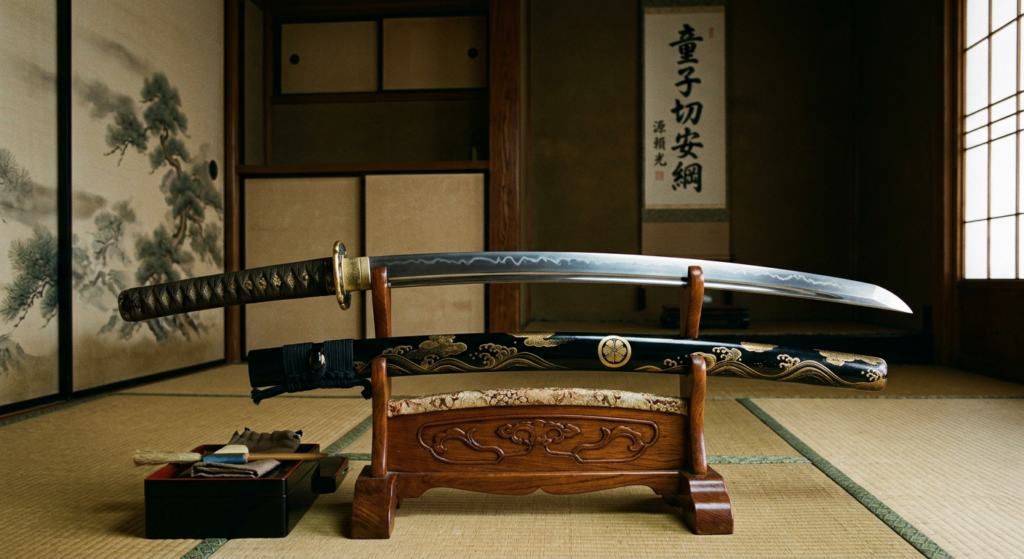
Why did the Japanese see divinity in swords?
Dojigiri Yasutsuna is a Japanese blade forged during the Heian period by the master swordsmith Ohara Yasutsuna.
It stands at the pinnacle of the “Tenka-Goken” — the Five Greatest Swords of Japan — and is designated as a National Treasure.
Often described as the finest sword ever made, it is famous for the legend in which the warrior Minamoto no Yorimitsu defeated the demon Shuten-doji.
Yet, its significance lies not in its strength, but in what people chose to fear—and to believe.
The blade features a calm and elegant straight temper line (hamon), while the steel surface is tightly forged and remarkably pure.
It represents technical perfection, yet evokes something beyond human craftsmanship.
Over time, a story emerged:
its spiritual power was so overwhelming that owners feared seeing demons in their dreams.
People feared it—and revered it.
In Japanese culture, fear and sacredness are often intertwined.
A sword was not merely a weapon, but a vessel for confronting the unseen.
Dojigiri Yasutsuna exists at the intersection of beauty, skill, and mythology.
It is not simply a blade, but a reflection of the Japanese spirit itself.
■ Cultural Notes
- In Japan, swordsmiths are regarded not only as craftsmen, but as figures embodying spiritual and sacred qualities.
- “Tenka-Goken” refers to the five most prestigious swords in Japan, representing the highest rank of cultural and artistic value.
- “Oni” (demons) symbolize not just monsters, but fear, disaster, and human inner darkness.
- Japanese swords are seen as more than weapons—they represent the soul of the samurai and objects of reverence.
- “Hamon” is the visible temper pattern on the blade, highly valued as an artistic element in Japanese sword culture.
Comments