
Imagine a tiny white bird, lighter than two U.S. nickels, with little black eyes, a button-sized beak, and feathers as soft-looking as fresh snow. Hidden in the winter forests of Hokkaido, Japan, lives a remarkable little creature with a surprisingly big story to tell.
The Wright Brothers News | November 22, 2026
Writer SAKURA
1. Somewhere in Japan, a Little Snowball Has Wings
Imagine a peaceful winter morning in Vermont.
Snow rests on the branches outside your kitchen window.
A black-capped chickadee appears.
It tilts its head, gives a cheerful call, and disappears into the trees.
For many Americans, watching little birds in winter is one of life’s quiet pleasures.
Now imagine traveling across the Pacific Ocean to northern Japan.
There, on the island of Hokkaido, lives a tiny bird that looks almost too adorable to be real.
Its face is almost completely white.
Its eyes resemble two tiny black beads.
Its round body looks like a cotton ball.
And behind that fluffy little body stretches a surprisingly long tail.
Meet the shimaenaga, affectionately known in Japan as the snow fairy.
The name may sound like something from a fairy tale, but this bird is very real.
It lives in forests, wooded parks, and other tree-filled places across Hokkaido.
And although its appearance makes people think of plush toys, marshmallows, and Christmas ornaments, the shimaenaga is a wild bird perfectly adapted to a challenging life.
Its story is about much more than being cute.
It is about surviving the cold, building extraordinary nests, caring for family, and finding beauty in the smallest creatures on Earth.
2. What Exactly Is a Shimaenaga?
The shimaenaga is the white-faced Hokkaido form of the Long-tailed Tit, scientifically known as Aegithalos caudatus.
Despite the English name, Long-tailed Tits do not belong to the same bird family as the chickadees familiar to American birdwatchers.
They belong to a separate family called Aegithalidae.
The shimaenaga is especially famous for its nearly all-white face.
Unlike many Long-tailed Tits in other parts of Japan, whose faces feature dark markings resembling eyebrows, adults of the Hokkaido form generally have clean white faces.
This gives them an unusually simple and endearing appearance.
Two black eyes.
One tiny beak.
And an almost perfectly round, fluffy white head.
It is easy to understand why people fall in love with these birds.
How tiny is tiny?
A shimaenaga typically weighs around 8 to 9 grams.
That is roughly 0.3 ounces.
For an American comparison, a U.S. nickel weighs 5 grams.
So this little bird weighs less than two nickels.
Its total length, including its long tail, is approximately 5 to 5.5 inches.
Much of that length is tail.
The body itself is remarkably small.
Imagine a little white cotton ball that can leap between branches, hang upside down while searching for food, and disappear into a forest in seconds.
That is the shimaenaga.
But its round appearance becomes even more fascinating when winter arrives.
3. Why Does the Shimaenaga Look Like a Fluffy Snowball?
If you have ever watched a chickadee or cardinal during a snowy American winter, you may have noticed something interesting.
On especially cold days, birds can look rounder than usual.
They puff out their feathers.
The same principle helps explain the shimaenaga’s famous snowball appearance.
Birds can raise and fluff their feathers to trap pockets of air close to their bodies.
Those pockets of air help reduce heat loss.
Think about your favorite winter jacket.
A down-filled coat works because the filling traps air, providing insulation against the cold.
Birds have their own remarkable version of this technology.
And they developed it long before humans invented winter clothing.
In Hokkaido, winter temperatures can fall well below freezing.
Snow covers mountains, forests, and towns.
Food can become more difficult to find.
For an animal weighing less than a third of an ounce, conserving energy is essential.
The shimaenaga’s soft plumage helps it survive.
What looks adorable to us is part of a serious survival strategy.
Nature has created something extraordinary.
A tiny bird’s winter coat happens to make it look like a living marshmallow.
4. America’s Chickadees Have a Japanese Look-Alike — but There’s a Surprise
American bird lovers are already familiar with several small, charming birds.
The black-capped chickadee is a favorite in northern states.
The Carolina chickadee is familiar across much of the Southeast.
In the western mountains, birdwatchers may encounter mountain chickadees.
And along parts of the Pacific Coast, chestnut-backed chickadees bring life to evergreen forests.
These birds share several traits with the shimaenaga.
They are small.
They are energetic.
They make high-pitched calls.
And they can look wonderfully round when they fluff their feathers.
But the resemblance is not the whole story.
Meet the Bushtit: An American Relative
If you live in California, Oregon, Washington, or other parts of the American West, you might have seen a little bird called the Bushtit.
Bushtits often move through bushes in lively groups.
They make soft, twittering calls while searching for insects.
They have small rounded bodies and relatively long tails.
Their plumage is generally brownish or gray rather than snowy white.
Here is the interesting connection:
The American Bushtit and Japan’s shimaenaga belong to the same bird family, Aegithalidae.
The familiar chickadee, despite looking somewhat similar, belongs to a different family.
So if you have watched a flock of Bushtits passing through a California garden, you have already encountered a relative of Japan’s famous snow fairy.
There is something beautiful about that connection.
A bird in an American backyard.
A white little bird in a Japanese forest.
Different continents, different colors, but related branches of the same remarkable family of birds.
Sometimes nature connects places that seem very far apart.
5. The Snow Fairy Doesn’t Turn White Just for Winter
One of the most common misunderstandings about the shimaenaga is that it becomes white when snow begins to fall.
It is a lovely idea.
A bird changes color to match the landscape, just as some animals develop white winter coats.
But that is not how the adult shimaenaga works.
Its distinctive white face is generally present throughout the year.
The white-headed appearance is a characteristic of Hokkaido’s form of the Long-tailed Tit, rather than a seasonal transformation.
Young birds can look different, showing darker facial markings before developing their adult appearance.
Another misconception is that shimaenaga arrive in Hokkaido only for winter.
In fact, they live there year-round.
Spring brings nesting.
Summer is a time of growth and activity.
Autumn brings changes in the forest.
And winter reveals the famous fluffy appearance that has made the bird so recognizable.
So why do people associate it so strongly with snow?
Partly because the bird looks especially round when its feathers are fluffed up in cold weather.
Partly because the contrast between its white face and dark eyes is so striking.
And partly because bare winter branches make little birds easier to spot.
It is the meeting of a real bird and a beautiful season.
No magic transformation is required.
The magic is already there.
6. A Tiny Bird That Builds an Incredible Home
Now comes one of the most surprising parts of the shimaenaga’s story.
Its nest.
You might expect a bird this small to build a simple little bowl made of twigs.
But Long-tailed Tits are extraordinary nest builders.
They construct enclosed, carefully concealed nests using materials such as moss, spider silk, and lichens.
Inside, they place soft feathers to help insulate the nest and protect their young.
Imagine having to build an entire home without hands.
Without tools.
Without tape.
Without glue from a hardware store.
Only a beak, two feet, and materials gathered from the surrounding forest.
Yet these tiny birds manage to create remarkably intricate structures.
A Home Made with Spider Silk
Spider silk is particularly useful because it is strong and flexible.
It helps hold the nest together while allowing some movement and expansion.
Lichens on the outside help the nest blend into nearby branches.
Feathers inside create a soft lining.
The result is an impressive piece of natural engineering.
It is not so different from what human architects try to achieve.
Strength.
Insulation.
Protection from weather.
And a structure suited to its surroundings.
Sometimes the most inspiring engineering can be found in a forest rather than a laboratory.
7. The Sweetest Surprise: Some Birds Help Raise Other Birds’ Babies
For many people, the most touching discovery about the shimaenaga may be its social life.
Long-tailed Tits are known for cooperative breeding.
That means some nesting pairs receive help from additional birds.
These helpers may bring food to the nestlings.
Often, they are birds whose own breeding attempts were unsuccessful, and many are related to one of the nesting adults.
They are not simply visitors watching from a nearby branch.
They can actively participate in feeding the young.
For a tiny bird raising a demanding brood, additional help can make a difference.
Is It Really Like an Extended Family?
There is a temptation to describe these birds as having little human families.
Grandparents.
Aunts.
Uncles.
Neighbors helping neighbors.
But we should be careful not to give wild birds human intentions that scientists cannot demonstrate.
Cooperative breeding has biological explanations involving survival and reproductive success.
The birds are not necessarily making decisions in the same way people do.
Still, the behavior is remarkable.
Small birds can maintain complex social relationships.
Their daily lives involve more than simply eating and flying.
They interact.
They communicate.
They reproduce.
And sometimes, they help raise young that are not their own.
The shimaenaga may look like a fluffy ornament.
But hidden inside that little snowball is a surprisingly sophisticated social life.
8. Why the Shimaenaga’s Family Life Reminds Us of American Birds
The shimaenaga’s cooperative behavior is not entirely unfamiliar in North America.
Remember the Bushtit?
American Bushtits also sometimes receive help from additional birds during the nesting season.
Their nests are different in appearance, often resembling long hanging pouches woven from plant fibers and spiderwebs.
But the connection is fascinating.
Both birds belong to the same family.
Both are highly social.
Both build elaborate nests.
And both can display cooperative breeding behavior.
For an American reader, this creates a new way of looking at local wildlife.
The next time you see a flock of little gray Bushtits moving through a tree in Oregon or California, imagine their white-faced relatives in the forests of northern Japan.
They may be separated by the Pacific Ocean.
Yet they share something that brings their stories together.
A small body, a remarkable home, and a life shaped by cooperation.
9. Winter Nights: When Staying Together Can Mean Staying Alive
Life in a snowy forest is not always peaceful.
A beautiful winter landscape can also be a demanding place to survive.
Tiny birds lose heat quickly.
Cold nights are especially challenging.
Long-tailed Tits are known to roost closely together during winter.
Birds may sit side by side along a branch, their bodies pressed close to one another.
This communal roosting can help them conserve heat.
It is a practical survival behavior, not simply an adorable scene.
Imagine how much energy such a small creature must use to keep its body warm.
Every calorie matters.
Every sheltered branch matters.
And contact with other birds can help.
There is something quietly moving about that image.
A forest becomes dark.
Temperatures fall.
Snow settles on the trees.
And a group of little birds gathers close together to face the night.
The scene is beautiful because it is real.
But its meaning is not merely sentimental.
It reminds us that life in the wild depends on countless small adaptations.
For the shimaenaga, companionship can be part of survival.
10. The Japanese Meaning Behind the Name “Shimaenaga”
The word shimaenaga is Japanese.
The second part, enaga, has an interesting origin.
It is associated with the shape of a traditional Japanese ladle.
Imagine an old-fashioned scoop with a rounded bowl and a long handle.
The bird’s tiny body resembles the bowl.
Its long tail resembles the handle.
The name reflects that shape.
The first part, shima, refers to the Hokkaido form of the bird.
The English nickname snow fairy is more poetic.
But both names reveal something about the relationship between people and nature.
One comes from careful observation of the bird’s silhouette.
The other expresses the delight people feel when they encounter it.
Japan also has a longstanding tradition of noticing beauty in small seasonal moments.
A single cherry blossom.
A snow-covered branch.
A quiet garden.
A bird calling from a tree.
The shimaenaga fits naturally into that world of attention to detail.
It does not need to be large or spectacular.
Its beauty is intimate.
Something you might miss if you walk too quickly.
11. Where Can You See Shimaenaga in Japan?
If seeing the shimaenaga in person is on your travel wish list, the place to remember is Hokkaido.
Hokkaido is Japan’s northernmost main island.
It is known for snowy winters, mountain landscapes, hot springs, forests, and wildlife.
Unlike much of Japan’s densely populated urban landscape, large parts of Hokkaido offer extensive wooded habitats.
Shimaenaga live in forested areas across the island, including some city parks.
A Real Observation from November 2026
Asahiyama Memorial Park in Sapporo is one place where the birds have been recorded.
According to the park’s bird observation report published on November 15, 2026, shimaenaga had been reported on nearly every day of the preceding week.
On November 13, observers recorded a flock of around seven or eight birds.
On November 14, a smaller group of three or four remained in the area for approximately 20 minutes, giving participants in a birdwatching event an opportunity to observe them.
These are actual park observations, not a promise that visitors will see the birds on any given day.
Wildlife does not follow a tourist schedule.
A bird seen yesterday may be somewhere else tomorrow.
But that uncertainty is part of what makes birdwatching special.
A Few Tips for American Visitors
If you visit Hokkaido hoping to see shimaenaga, think of the experience as a quiet nature walk, not a guaranteed wildlife attraction.
Wear warm layers and waterproof winter footwear.
Bring binoculars or a camera with a zoom lens.
Listen for soft, high-pitched calls.
Watch small groups moving through bare branches.
And be patient.
A bird weighing less than two nickels can disappear surprisingly quickly.
It may take time to spot one.
But when that tiny white face finally appears between branches, the moment can feel unforgettable.
12. How to Photograph a Snow Fairy Without Harming It
Shimaenaga photographs are wonderfully appealing.
Their round faces and tiny expressions almost seem designed for social media.
But wildlife photography comes with responsibility.
The National Audubon Society provides guidance on ethical bird photography that applies well beyond North America.
Give birds space.
Avoid disturbing nests.
Do not use recorded calls to lure birds toward you.
Do not chase wildlife for a better angle.
And do not damage vegetation or habitat to create a cleaner photograph.
The goal should be to document the bird’s natural behavior, not to change it.
The Best Photograph May Be the One You Never Take
Imagine spotting a shimaenaga in a snowy tree.
For a moment, it looks directly toward you.
You lift your camera.
But the bird moves away before you can take the picture.
Perhaps the most meaningful part of that experience is not a photograph at all.
It is the knowledge that you were allowed to witness a small part of another creature’s life.
You can remember the sound.
The winter light.
The falling snow.
And the quick movement of the bird as it disappeared into the branches.
Beautiful things do not always need to be captured.
Sometimes they only need to be noticed.
13. What Americans Can Learn from Japan’s Snow Fairy
In the United States, birdwatching often begins at home.
A chickadee visits a feeder in New England.
A cardinal brightens a snowy yard in the Midwest.
A Bushtit flock travels through shrubs on the West Coast.
A tiny nuthatch moves down the trunk of a tree.
These familiar encounters can inspire curiosity about nature.
The shimaenaga offers another reason to look closely at the birds around us.
Its unusual appearance captures our attention.
But its life teaches us to appreciate more than appearances.
The feathers help protect it from the cold.
Its nest is an engineering achievement.
Its social behavior reveals the complexity of wild animals.
Its life in the forest depends on shelter, food, and a functioning habitat.
And its beautiful white face reminds us how much diversity exists within the natural world.
A Different Kind of Travel Souvenir
When Americans visit Japan, the most memorable experiences are not always the famous landmarks.
Sometimes it is a quiet street in Kyoto.
A mountain view in Hokkaido.
The sound of rain in a garden.
Or the first glimpse of a bird you had only seen in photographs.
You might forget exactly what you bought at a souvenir shop.
But you may remember a tiny white bird that appeared in a winter tree for only a few seconds.
The best journeys change what we notice when we return home.
After meeting the shimaenaga, you may look a little more carefully at the birds in your own backyard.
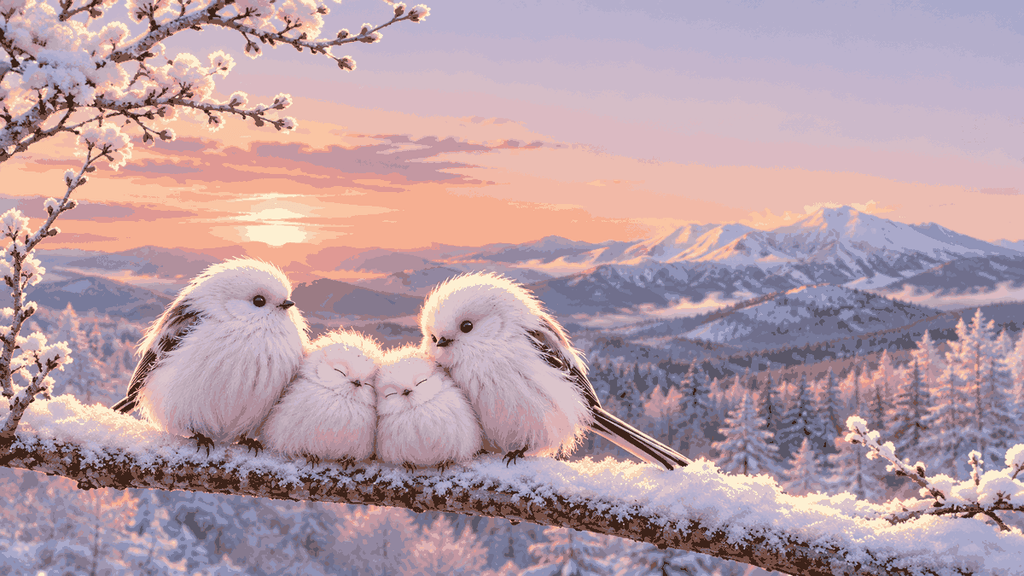
14. A Family of Four Beneath a Hokkaido Sunset
Picture the last light of a winter evening spreading across the mountains of Hokkaido.
The sky turns from pale gold to soft pink.
Snow-covered trees stand quietly along the slopes.
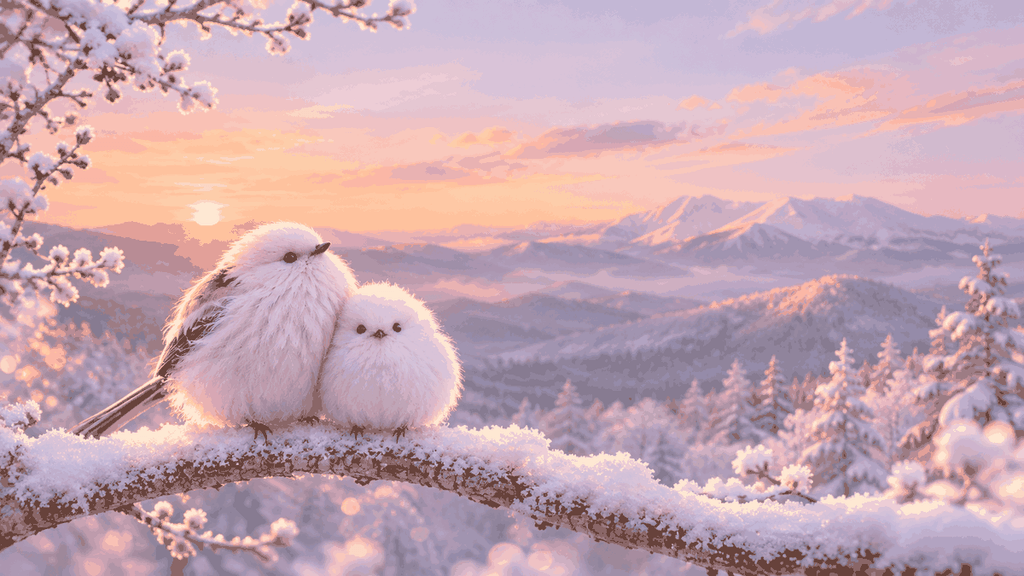
On a branch overlooking the valley, four little white birds sit close together.
Two adults remain awake.
Two smaller birds seem to be sleeping peacefully between them.
It is an imagined scene, inspired by the beauty of the shimaenaga.
Not a photograph documenting a real family, nor a literal account of how chicks are raised during winter.
The artistic image accompanying this story was created to express a feeling of safety, warmth, and affection.
Real shimaenaga begin their breeding activities in the colder months leading toward spring, and young birds generally fledge later in the season.
Their actual social groups are more complex than the simple human family pictured in an illustration.
Yet the image speaks to something recognizable.
The desire for shelter.
The comfort of closeness.
The quiet beauty of a peaceful evening.
Across cultures and continents, we understand these feelings.
Perhaps that is why photographs and illustrations of tiny birds huddling together can be so moving.
We see wild animals.
And we are reminded of the importance of caring for one another.
15. The World’s Cutest Bird Has Something Important to Teach Us
We live in a world filled with extraordinary images.
Towering mountains.
Beautiful oceans.
Massive whales.
Distant galaxies.
Spectacular sunsets.
It can be easy to think that beauty must be grand to be meaningful.
But the shimaenaga suggests otherwise.
Sometimes beauty weighs only eight grams.
Sometimes it has two tiny black eyes.
Sometimes it hides in a tree and appears for only a few seconds.
And sometimes its most remarkable qualities cannot be seen in a photograph at all.
They are found in the way it survives winter.
The way it builds its nest.
The way it lives with other birds.
And the way its presence reminds us to look more carefully at nature.
The next time you see a little bird outside your window, take a moment to watch.
Perhaps it will be a chickadee.
Perhaps a Bushtit.
Perhaps another familiar backyard visitor.
You do not have to travel across the Pacific to discover something remarkable.
Nature has already placed small wonders all around us.
And somewhere in the snowy forests of Hokkaido, the shimaenaga continues its busy little life.
Hopping from branch to branch.
Searching for food.
Calling to its companions.
Surviving another winter day.
Unaware that people thousands of miles away have fallen in love with its face.
A tiny bird. A beautiful world. And one more reason to be gentle with the nature we share.
Written by Writer SAKURA
The Wright Brothers News — Discovering the beautiful, surprising, and heartwarming side of Japan.
Editor’s note: The shimaenaga family scenes accompanying this article are AI-generated artistic illustrations. They are not photographs of actual birds or documented wildlife encounters.
References and Further Reading
- Cornell Lab of Ornithology — Long-tailed Tit: https://www.allaboutbirds.org/guide/Long-tailed_Tit/overview
- Cornell Lab of Ornithology — Bushtit: https://www.allaboutbirds.org/guide/Bushtit/overview
- BirdLife International — Snow Fairies in a Winter Wonderland: https://www.birdlife.org/news/2023/02/01/snow-fairies-in-a-winter-wonderland/
- Sapporo Asahiyama Memorial Park — Bird Observation Report, November 15, 2026: https://www.sapporo-park.or.jp/asahiyama/?p=27034
- National Audubon Society — Ethical Bird Photography: https://www.audubon.org/photography/awards/audubons-guide-ethical-bird-photography-and-videography
Comments