
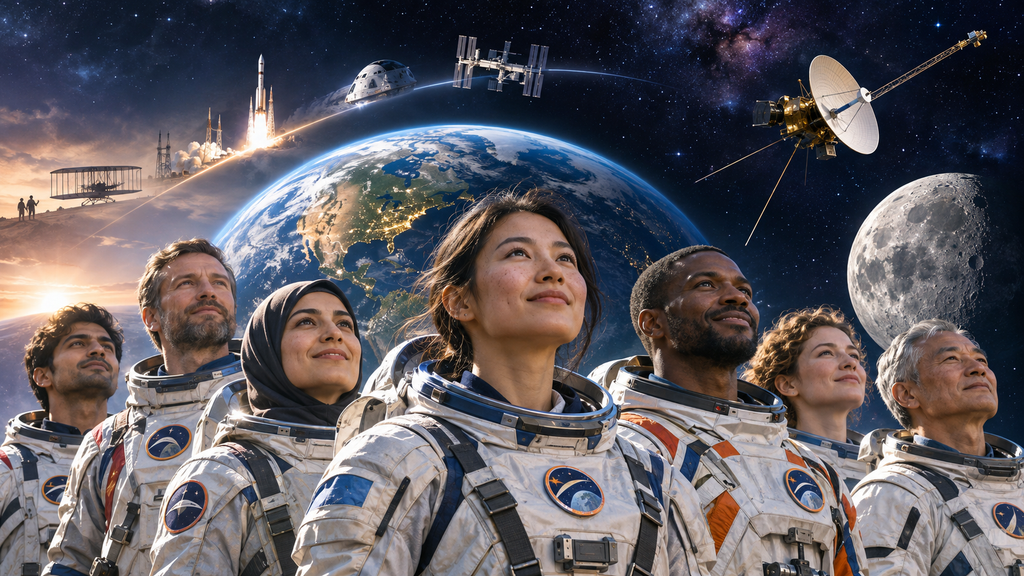
NASA’s Voyager 1 has reached a historic distance from Earth. But behind this extraordinary milestone is a much bigger story—one connecting the United States, Canada, Japan, Europe, India, China, and the astronauts whose lives reveal what it truly means to explore space.
By The Wright Brothers News | November 20, 2026
A Journey That Began With Just 12 Seconds
On December 17, 1903, Orville Wright took off from the sand near Kitty Hawk, North Carolina, in an aircraft built with his brother Wilbur.
The flight lasted just 12 seconds and covered approximately 36.6 meters (120 feet).
More than 123 years later, on November 18, 2026, humanity’s most distant spacecraft reached a place so far from Earth that even light takes an entire day to get there.
That spacecraft is NASA’s Voyager 1.
Launched on September 5, 1977, Voyager 1 has been traveling through space for more than 49 years. According to NASA’s Jet Propulsion Laboratory, it reached a distance of approximately 25.9 billion kilometers, or 16.1 billion miles, from Earth at 2:16 a.m. Pacific Standard Time on November 18.
This distance is known as one light-day.
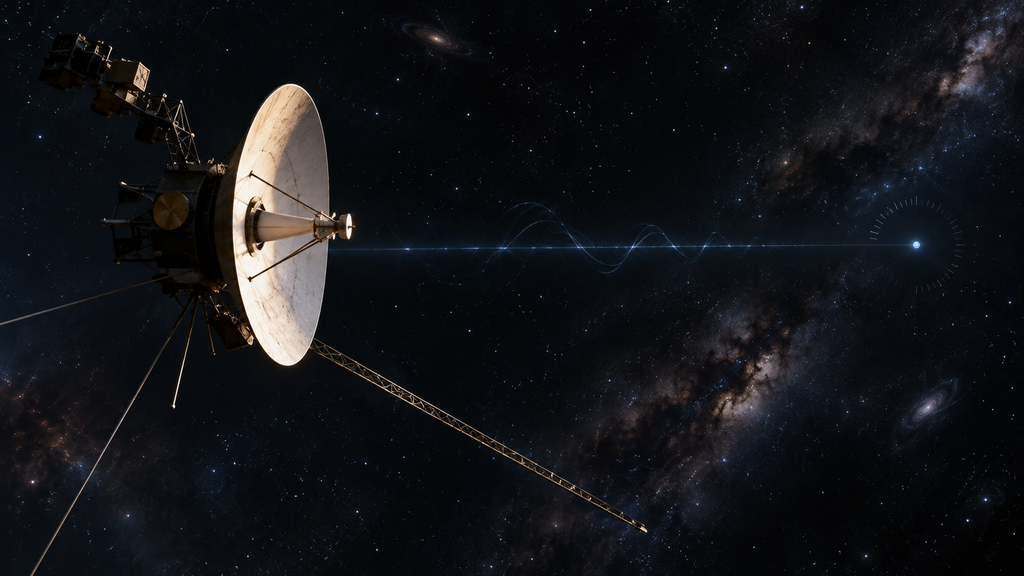
A radio signal traveling from Voyager 1 to Earth now takes about 24 hours to arrive. A command sent from Earth and a response returned from the spacecraft would require approximately 48 hours of signal travel alone.
Voyager 1 carries no astronauts. It is an uncrewed robotic explorer.
Yet the spacecraft’s achievement raises a deeply human question:
Who are the people carrying forward the journey that began with the Wright brothers—and which nations will shape humanity’s next great leap?
The answer stretches from NASA’s mission control rooms to a Canadian farm, from a Japanese astronaut’s work in Rwanda to a former Hong Kong police officer now living in orbit.
The Historic Milestone Comes With a Communications Challenge
Voyager 1 is not simply an abandoned relic drifting through space.
After exploring Jupiter and Saturn, it crossed the heliopause—the outer boundary of the Sun’s protective bubble of plasma and magnetic fields—in 2012.
Its twin, Voyager 2, entered interstellar space in 2018 after exploring all four giant planets.
Both spacecraft have transformed scientists’ understanding of the outer solar system and the environment between the stars.
But their age presents a growing challenge.
In April 2026, NASA switched off one of Voyager 1’s scientific instruments to conserve the spacecraft’s dwindling electrical power.
Then, on November 14, engineers discovered another problem.
An antenna at NASA’s Deep Space Network facility in Canberra, Australia, detected Voyager 1’s radio carrier signal but received no accompanying scientific or engineering data.
As of November 20, the cause remained under investigation.
NASA nevertheless confirmed the one-light-day milestone using the carrier
Comments