
August 17, 2026 | The Wright Brothers News
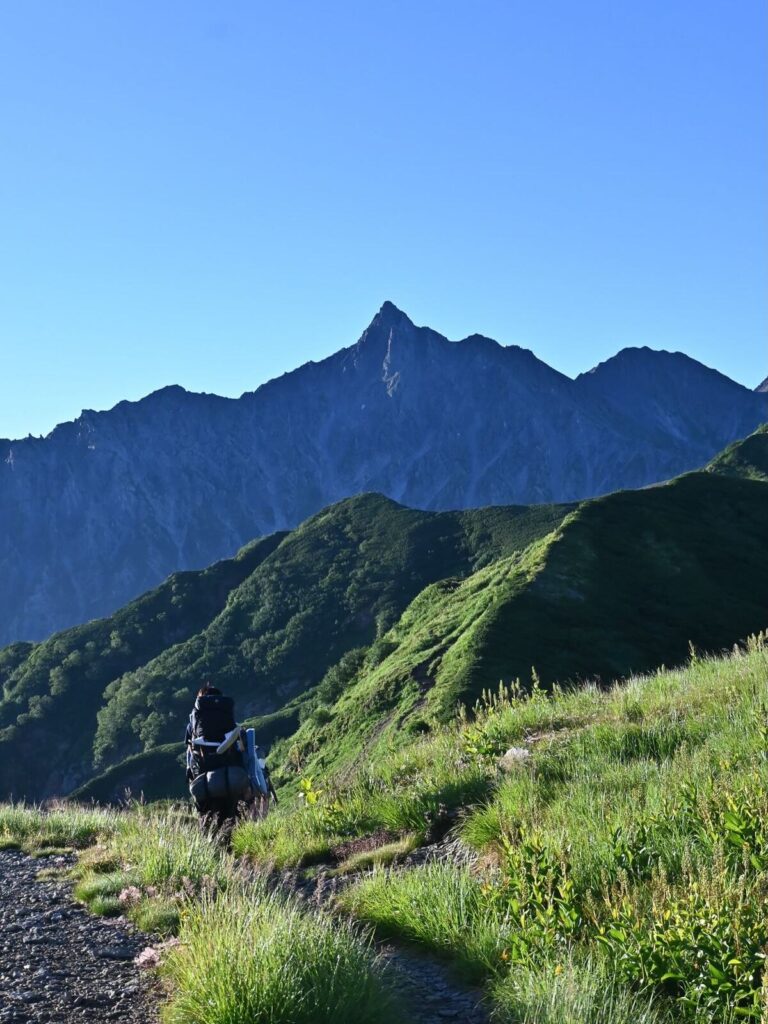
There is a moment in the mountains when nobody speaks.
Not because there is nothing to say.
But because words suddenly feel too small.
The sun has not fully risen.
The world below is still sleeping.
Your legs are tired.
Your shoulders hurt beneath the weight of your pack.
Your breathing is louder than you remember.
And somewhere ahead of you, cutting into the blue Japanese sky, stands a mountain.
It does not know your name.
It does not know your job.
It does not know how much money you make.
It does not know how many followers you have.
It does not know whether you succeeded yesterday.
And it does not care how many times you failed.
Up here, you are simply a human being.
Walking.
Breathing.
Trying to take one more step.
Somewhere High in the Japanese Alps
These photographs were taken in Chubusangaku National Park, home to much of Japan’s Northern Alps.
Established in 1934 as one of Japan’s first national parks, this vast mountain landscape stretches across parts of Nagano, Toyama, Gifu and Niigata prefectures.
Here rise some of Japan’s most extraordinary mountains.
Mount Oku-Hotakadake.
Mount Norikura.
And the unmistakable spear-shaped summit of Mount Yarigatake.
Ten of Japan’s 21 mountains exceeding 3,000 meters stand within this national park.
But numbers cannot explain this place.
You have to walk.
The Mountain Does Not Carry You
At the beginning of a climb, people often look toward the summit.
It seems impossibly far away.
So you walk.
One step.
Then another.
And another.
At first, you talk with the people beside you.
You laugh.
You take photographs.
You talk about work.
About food.
About where you came from.
Eventually, the mountain makes the conversation quieter.
The air gets thinner.
The pack gets heavier.
The trail becomes steeper.
And little by little, unnecessary things disappear.
You stop thinking about next week.
You stop checking what other people are doing.
You stop wondering whether someone somewhere is more successful than you.
There is only the next stone.
The next breath.
The next step.
Mountains have a strange way of reducing life to what matters.
Everyone Climbs Differently
Walk a mountain trail long enough and you begin to notice something.
Nobody climbs exactly the same way.
One person walks quickly.
Another walks slowly.
Someone stops every twenty minutes.
Someone hardly stops at all.
One carries a huge backpack.
Another carries almost nothing.
Someone is young.
Someone is seventy.
Someone has climbed a hundred mountains.
Someone is standing above the clouds for the first time.
And yet the mountain does not say:
“Only the fastest person belongs here.”
There is room on the trail for all of them.
Perhaps society could learn something from that.
Yesterday, We Wrote About Diversity
Yesterday, The Wright Brothers News told the story of 1,779 Japanese companies working toward Diversity, Equity and Inclusion through the network of JCI Japan.
It was a story about organizations.
Companies.
Leadership.
Society.
But diversity is sometimes easier to understand when we leave the conference room behind.
Look at these mountains.
No two peaks have the same shape.
No two rocks are identical.
The alpine flowers do not ask the grass to become flowers.
The grass does not ask the mountain to become a forest.
The mountain does not ask the lake to become a mountain.
And yet somehow—
together—
they create one landscape.
Maybe diversity was never complicated.
Maybe nature has been showing us how it works all along.
A Mountain Is Beautiful Because It Is Not Perfect
Look closely at a mountain.
It is scarred.
Broken.
Uneven.
There are cliffs where nothing grows.
There are rocks split by ice.
There are valleys carved over enormous stretches of time.
There are places destroyed by landslides.
There are trees bent by snow and wind.
And still we call it beautiful.
We do not stand before a mountain and say:
“It would be more beautiful if every part were smooth.”
We admire it precisely because it isn’t.
So why are human beings sometimes so cruel to themselves for being imperfect?
Why do we hide our scars?
Why do we compare our lives with someone else’s?
Why do we believe everyone must reach the same place at the same age?
Graduate at this age.
Get a job at this age.
Marry at this age.
Have children at this age.
Become successful at this age.
Life was never a straight trail.
Neither is a mountain.
Sometimes, the Person Behind You Becomes the Person Who Saves You
There is another lesson mountains teach quickly.
You cannot always do everything alone.
Someone tells you:
“Watch that rock.”
Someone waits when you fall behind.
Someone shares water.
Someone checks the weather.
Someone says:
“We should turn back.”
Sometimes the strongest person in the group carries someone else’s equipment.
Sometimes the slowest person notices something everyone else missed.
Sometimes the person you helped yesterday is the person who helps you tomorrow.
On a mountain, dependence is not weakness.
It is survival.
Perhaps down in our cities, we have simply become too good at pretending we don’t need one another.
There Is Courage in Turning Back
People love photographs from summits.
We rarely post photographs titled:
“We turned around.”
But experienced mountaineers understand something important.
Reaching the summit is optional.
Coming home is not.
Weather changes.
Bodies change.
Conditions change.
Sometimes the bravest decision is not to continue.
It is to say:
Not today.
That is not failure.
The mountain will still be there.
And perhaps this is another lesson worth carrying back into ordinary life.
Not every dream has to be achieved today.
Not every battle has to be won.
Not every path must be followed simply because we started walking it.
Sometimes changing direction is wisdom.
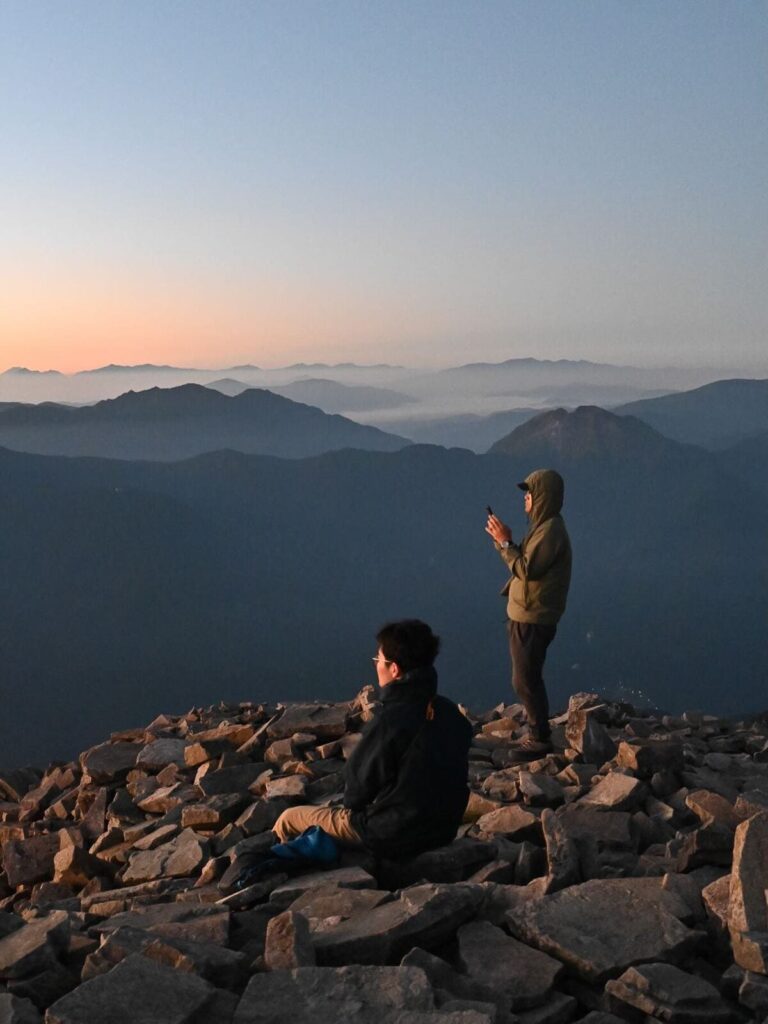
Then Morning Comes
If you keep climbing, sometimes you are given a moment that makes every painful step disappear.
The darkness begins to soften.
Black mountains become blue.
The horizon turns orange.
And then—
the sun appears.
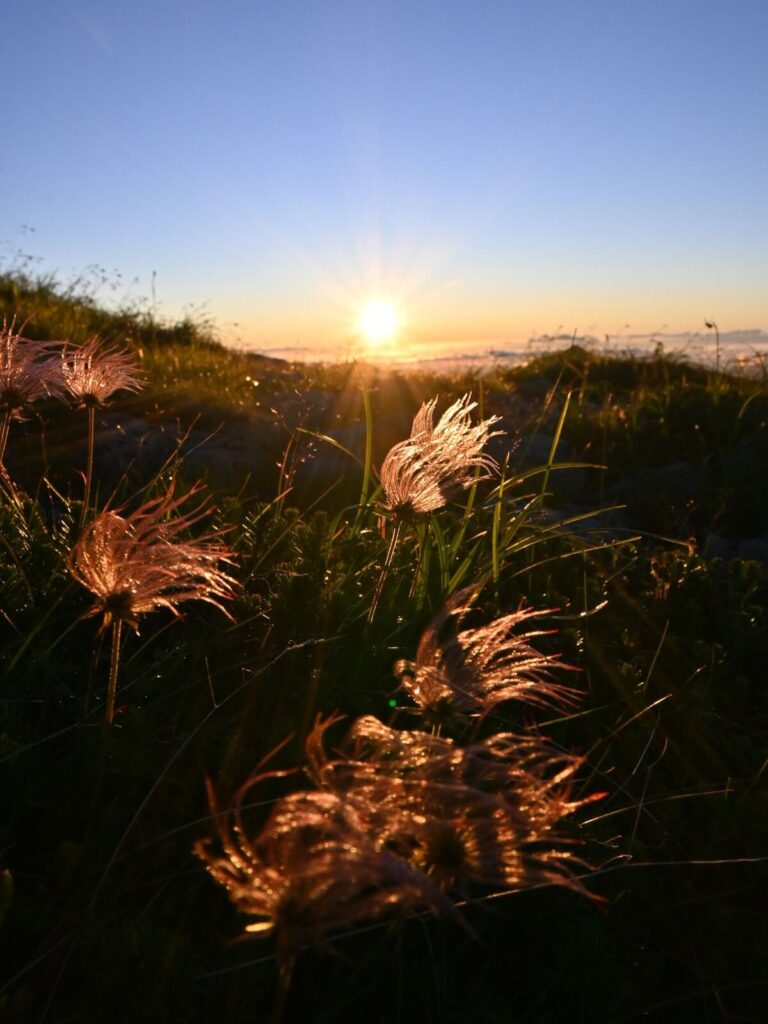
For a few minutes, the light touches everything.
Rocks that looked cold become gold.
Tiny alpine plants glow in the morning wind.
Mountains that were invisible during the night emerge one after another in the distance.
And you realize something almost embarrassingly simple.
The sun was always coming.
You just couldn’t see it yet.
There are periods in life like that.
When we cannot see beyond the darkness immediately in front of us.
When tomorrow feels impossibly far away.
When we begin to wonder whether the light is actually coming.
The mountain gives no speeches.
It simply lets morning happen.
And somehow that is enough.
Somewhere Below, Someone Is Still Climbing
From a summit, it is tempting to feel that you have arrived.
Then you look down.
Far below, someone is walking the same trail you walked hours earlier.
A tiny figure.
A backpack.
One step at a time.
You know exactly how tired that person might be.
And suddenly the summit feels different.
Because you remember:
not long ago,
that was you.
Perhaps success should make us kinder for the same reason.
When you finally reach somewhere another person is struggling to reach, do not laugh at how slowly they are climbing.
Remember your own climb.
Maybe reach down.
Maybe tell them:
“Keep going. The view is worth it.”
The Mountain Does Not Ask Where You Were Born
The mountain does not care whether you are Japanese or American.
Chinese or Indian.
French or German.
Italian or Spanish.
Arab or Russian.
Brazilian or Indonesian.
It does not care what language you speak.
The wind sounds the same.
Cold feels the same.
Fatigue feels the same.
A helping hand means the same.
And sunrise needs no translation.
Perhaps this is why mountains can make strangers become companions so quickly.
Up here, many of the labels we carry below become surprisingly light.
What remains is human.
Japan Is More Than Tokyo
When people overseas imagine Japan, they often see Tokyo first.
Shibuya Crossing.
Neon signs.
Bullet trains.
Anime.
Technology.
Convenience stores.
All of those things are Japan.
But this is Japan too.
A narrow trail disappearing into green mountains.
Morning light catching alpine plants.
A hiker walking silently beneath a giant peak.
Cold water reflecting the mountains so perfectly that, for a moment, you cannot tell which world is real.
The Northern Japanese Alps contain towering peaks, glacial valleys, alpine flower fields, deep gorges and landscapes shaped by snow, ice and volcanic activity.
This is another face of Japan.
Quiet.
Ancient.
Unhurried.
And breathtakingly beautiful.
These Mountains Have Watched Generations Pass
Humans have crossed and revered these mountains for generations.
Some mountains in what is now Chubusangaku National Park were historically regarded as sacred, and Mount Tateyama became an important pilgrimage destination. The region later became central to the development of recreational mountaineering in Japan; British missionary Walter Weston helped introduce these mountains to a wider audience, contributing to the popularization of what became known as the Japanese Alps.
People changed.
Governments changed.
Cities grew.
Technology transformed our lives.
But the mountains remained.
Perhaps that is part of why standing here feels different.
For a brief moment, our problems become smaller.
Not meaningless.
Just smaller.
The Reflection in the Water
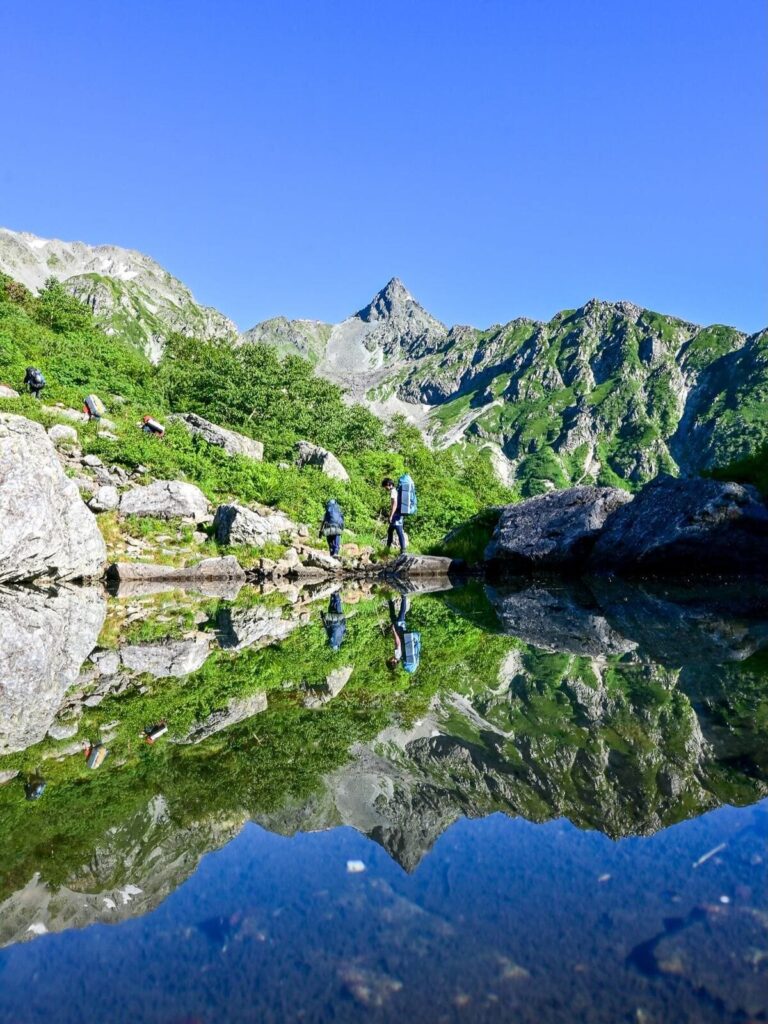
One of these photographs contains a mountain twice.
Once above.
Once reflected below.
The reflection is almost perfect.
But touch the water—
and it disappears.
Human beings are often like that reflection.
We spend enormous energy maintaining an image of ourselves.
Successful.
Strong.
Happy.
Confident.
Perfect.
Then life touches the surface.
A failure.
A goodbye.
An illness in the family.
A dream that does not happen.
A relationship that ends.
A mistake we cannot undo.
And the image breaks apart.
But look again.
The mountain itself is still there.
Perhaps who you really are is not the reflection.
Not your title.
Not your reputation.
Not the version of yourself other people see.
Maybe you are the mountain underneath it.
Still there when the surface shakes.
You Will Not Always Be Strong
There will be days when someone else walks faster than you.
Let them.
There will be days when you need to rest.
Rest.
There will be days when the weather turns and you have to go back.
Go back.
There will be days when someone needs your hand.
Give it.
And there will be days when you need theirs.
Take it.
A mountain does not become smaller because you climbed slowly.
And your life does not become less valuable because someone else reached something before you.
What Japan’s Mountains Whisper
Japanese culture often speaks of wa — 和, harmony.
Harmony does not mean everything is identical.
A mountain landscape proves the opposite.
Rock.
Water.
Grass.
Flowers.
Snow.
Cloud.
Sunlight.
Shadow.
Every element is different.
The beauty comes from their coexistence.
Maybe human society is no different.
Yesterday we called it diversity.
Today, standing among the mountains of Japan, perhaps we can call it something simpler:
making room for one another.
One Day, We All Walk Down the Mountain
No one stays on the summit forever.
Eventually, everyone descends.
That may be the most important lesson.
Achievements fade.
Titles change.
Records are broken.
Companies disappear.
Even photographs grow old.
What remains is often something much quieter.
Who walked beside you?
Who waited for you?
Whose backpack did you carry?
Who gave you water?
Who made you laugh when you were exhausted?
Who pointed toward the sunrise and said:
“Look.”
Maybe life is not really about standing on the highest mountain.
Maybe it is about becoming the kind of person someone is grateful to have beside them on the trail.
To Whoever Is Climbing Right Now
Maybe your mountain is not made of rock.
Maybe it is work.
Money.
Family.
Loneliness.
A dream.
A new country.
A new language.
A failure nobody knows about.
Or simply getting through tomorrow.
We cannot see the mountain you are climbing.
But these photographs from Japan carry a message for you.
You do not have to climb at someone else’s speed.
You do not have to look strong every moment.
You are allowed to rest.
You are allowed to ask for help.
You are allowed to turn back and try another day.
And when everything around you still looks dark—
remember the mountains before sunrise.
The light may already be on its way.
You simply cannot see it yet.
One more step.
Then another.
The summit is not going anywhere.
And neither is tomorrow.
Editor’s Notes
Chubusangaku National Park (中部山岳国立公園) was established on December 4, 1934, making it one of Japan’s earliest national parks. It covers approximately 174,323 hectares across the mountainous heart of central Japan.
The park encompasses much of the Northern Japanese Alps, including major mountain areas such as the Tateyama Range, Ushiro-Tateyama Range, Hotaka Range, Mount Yarigatake and Mount Norikura.
The park contains 10 of Japan’s 21 peaks above 3,000 meters. Among them are Mount Oku-Hotakadake at 3,190 meters and the distinctive Mount Yarigatake at 3,180 meters.
Its landscape includes sheer rock walls, deep gorges, alpine flower fields, lingering snowfields, glacially carved valleys, forests, lakes and volcanic terrain.
For visitors planning to hike in the Japanese Alps, conditions can change quickly at altitude. Official guidance recommends checking current weather and trail information and avoiding overexertion. Visitor centers provide current trail and safety information.
Photography: Chubusangaku National Park, Japan
Comments
List of comments (4)
Hi~(* ̄▽ ̄*)
Honestly, it’s really good
So,I like it
I like this