
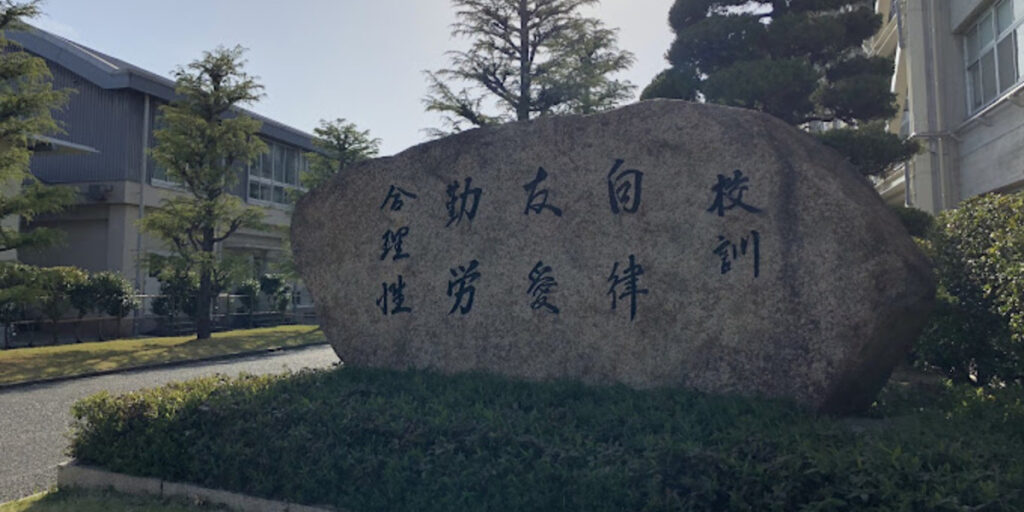
Japan’s Ministry of Education, Culture, Sports, Science and Technology, known as MEXT, has selected two public high schools in Okayama Prefecture as pilot schools under the national “N-E.X.T. High School” reform initiative.
The selected schools are Okayama Prefectural Higashi Okayama Technical High School and Okayama Prefectural Okayama Sozan High School. They are part of a broader 2026 announcement in which MEXT named 75 schools and institutions across 38 local governments as leading sites for high school reform.
The N-E.X.T. High School initiative is Japan’s long-range education reform plan aimed at 2040. Its goal is to redesign high school education around three major needs: preparing students for an AI-driven economy, strengthening STEM and digital learning, and preserving access to high-quality education in rural or shrinking communities.
For American readers, the program can be understood as a mix of career and technical education modernization, STEM magnet-school expansion, dual-purpose workforce development, and rural education access reform. But unlike many U.S. programs that are district-led or state-led, Japan’s model is being pushed through a national policy framework, with prefectures receiving public funding to create regional pilot hubs.
Higashi Okayama Technical High School was selected for a project focused on training advanced technical professionals who can support next-generation industries. The school already has specialized departments such as mechanical engineering, electrical engineering, electronic mechanics, industrial chemistry, and facility systems. Under the new initiative, it is expected to strengthen digital, entrepreneurial, and industry-linked education.
Okayama Sozan High School, by contrast, represents the academic and STEM inquiry side of the reform. Its project focuses on building a hub for students with science-oriented skills and interdisciplinary research abilities. The school includes both full-time and correspondence education, making it a useful case for combining advanced academic learning with more flexible forms of high school access.
The contrast between the two Okayama schools is important. One is a technical high school preparing students for advanced industrial careers. The other is an academic high school building stronger STEM and cross-disciplinary inquiry. Together, they show how Japan is trying to move beyond the older divide between “college prep” and “vocational” education.
MEXT’s national documents frame the reform around Japan’s looming 2040 challenges: population decline, labor shortages, rural depopulation, the need for more science and engineering talent, and the rise of AI. The ministry argues that high schools must help students develop abilities that cannot easily be replaced by AI, including problem-finding, communication, collaboration, information literacy, and the capacity to create value with others.
The funding structure also matters. MEXT’s grant guidelines state that the program creates prefectural funds to support reform-leading hubs in public high schools. In other words, these schools are not just receiving support for isolated projects. They are expected to test models that can later spread across the wider regional school system.
Across Japan, the 75 selected schools include 34 general academic departments, 22 industrial departments, and 14 agricultural departments, among others. This shows that the reform is not limited to elite academic schools. It also targets technical, agricultural, commercial, fisheries, and flexible-learning institutions.
For the United States, Japan’s N.E.X.T. High School initiative is worth watching because it addresses a problem both countries share: how to make high school matter in an economy shaped by AI, demographic change, and regional inequality. Japan’s answer is to turn selected public high schools into regional innovation hubs. The Okayama case shows that this reform is not only about producing more engineers. It is about redesigning the purpose of high school itself.
Deep Notes for American Readers
- What is MEXT?
MEXT is Japan’s national education ministry. It plays a much more centralized role than the U.S. Department of Education. In the United States, curriculum and school governance are heavily shaped by states, districts, and local boards. In Japan, national policy has stronger influence over the structure and direction of public education. - What does “prefecture” mean?
A prefecture is Japan’s equivalent of a state-level administrative unit. Okayama Prefecture is in western Japan, between Osaka/Hiroshima and the Seto Inland Sea region. When MEXT funds prefectures, it is closer to the federal government funding state-level education reform, though Japan’s system is more centralized than the U.S. system. - Why 2040?
Japan often uses 2040 as a policy horizon because demographic pressure becomes especially severe by then. The country faces a shrinking workforce, aging communities, and rural depopulation. For schools, this means fewer students, harder staffing problems, and the risk that small communities lose access to diverse course offerings. - Why are technical high schools important in Japan?
Japanese technical high schools are not simply “shop class.” Many are specialized public high schools with multi-year programs in engineering, manufacturing, electricity, robotics, chemistry, construction, or information systems. They often connect directly with regional employers. Higashi Okayama Technical High School fits this tradition. - How is this different from U.S. career and technical education?
The closest U.S. comparison is CTE, vocational-technical high schools, or regional career academies. The difference is that Japan’s reform is being explicitly tied to national industrial policy, AI readiness, STEM shortages, and regional revitalization. It is not only about job training; it is about turning high schools into local innovation infrastructure. - What does “advanced essential worker” mean?
MEXT uses the term “Advanced Essential Worker” to describe highly skilled people who support core industries and social infrastructure while also using digital tools, AI, and advanced technical knowledge. In U.S. terms, think of a next-generation technician, applied engineer, smart manufacturing worker, energy systems specialist, or infrastructure technologist. - Why include an academic high school like Okayama Sozan?
Japan’s reform is not only focused on vocational education. Okayama Sozan’s project points to another national concern: producing more students with STEM literacy, data skills, and interdisciplinary research ability. This resembles U.S. debates around STEM magnets, early research programs, and project-based learning in college-prep schools. - Why does correspondence education matter?
Okayama Sozan includes a correspondence program. In Japan, correspondence high schools have grown as more students seek flexible pathways because of health issues, school refusal, work, family circumstances, or alternative learning needs. Including such schools in reform reflects MEXT’s concern that “high quality learning” should not depend only on attending a traditional full-time campus. - Why does this matter outside Japan?
Both Japan and the U.S. are struggling with the same question: what should high school prepare students for when AI changes work, rural regions lose population, and traditional college-vs-career pathways no longer explain the whole economy? Japan’s approach offers one model: fund selected schools as regional laboratories, then spread what works.
SEO Tags
N-E.X.T. High School, Japan education reform, MEXT, Japanese high school reform, Okayama education, Higashi Okayama Technical High School, Okayama Sozan High School, STEM education Japan, AI education Japan, career and technical education Japan, vocational high school Japan, Japan workforce development, 2040 Japan education, rural education Japan, advanced essential workers, Japanese technical high schools
Source Links
- MEXT adoption results page: https://www.mext.go.jp/b_menu/boshu/mext_00074.html
- MEXT selected schools PDF: https://www.mext.go.jp/content/20260629-mxt.kouhou02-000049080_01.pdf
- MEXT high school reform grand design outline: https://www.mext.go.jp/content/20251128-mxt_koukou01-000046079_01.pdf
- MEXT grant guidelines: https://www.mext.go.jp/content/20260206-mxt_koukou02-000047191_02.pdf
- Higashi Okayama Technical High School: https://www.toko.okayama-c.ed.jp/wp/
- Okayama Sozan High School: https://www.sozan.okayama-c.ed.jp/
- ReseEd report: https://reseed.resemom.jp/article/2026/06/30/13578.html
Comments